

- Salle de réunion du 1e étage, LEM3 - site Metz Technopôle, Metz
 anglais
Abstract
The attraction of exploration and colonization of the Moon, our nearest celestial body, has long captivated humanity’s imagination. The recent worldwide resurgence of interest in lunar exploration includes significant plan for establishing civil engineering infrastructure for long duration human presence.
The United States is committed to return to the Moon for long-term human settlement by establishing a permanent US lunar station. Several other countries and private industry worldwide are also planning to go to the Moon. In preparation of returning to the Moon, there have been several noteworthy initiatives and projects undertaken by the National Aeronautics and Space Administration (NASA) on areas, including but not limited to, advanced space transportation, power and propulsion, deployable space structures, advanced space life support systems, and human exploration and development of space. There are numerous benefits from the exploration and development of the Moon, including mining; energy harvesting; medical, scientific and engineering research and innovation; expanding international cooperation in space; astronomy – better understand our universe; and making stepping stone to explore other planetary and space voyages. However, the lunar environment is unique and remarkably different and harsh from that on Earth.
Lunar environment consists of hard vacuum, lack of atmosphere, long diurnal cycle of extreme temperature variation, dangerous radiation exposure, reduced gravity (1/6th of that on Earth’s surface), hypervelocity micro meteoroid impact, moonquakes, and abrasive/charged dust particles. Structures, facilities, and infrastructure built on the Moon for human settlement should be designed and constructed to withstand these extreme environmental elements.
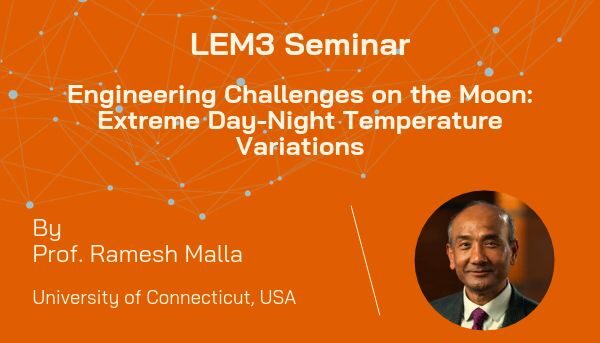
This seminar presentation will begin with introducing the extreme environmental conditions that exist on the Moon, the engineering and construction challenges they pose and discuss on various proposed structural concepts. It will then present the determination of lunar surface and sub-surface temperature based on fundamental physics-based thermodynamic concept. It will also briefly outline scheme to determine temperature on a lunar structure.
About the speaker
Ramesh B. Malla, Ph.D. is a Professor of Structural Engineering and Applied Mechanics, School of Civil & Environmental Engineering at the University of Connecticut (UConn), Storrs, CT, U.S.A. He has more than 45 years of teaching, research, and industrial experience, including 41 years at UConn. In addition to being a faculty member, Prof. Malla worked as a structural engineer at United Engineers & Constructors, Inc. in Philadelphia, PA; a Visiting Faculty Fellow at the NASA Lewis (now Glenn) Research Center, Cleveland, OH and a Visiting Faculty at Hamilton Sundstrand Space Systems International, Inc. (now Collins Aerospace) in Connecticut. He served as the Founding UConn Campus Director of the NASA/Connecticut Space Grant College Consortium (1991-2000) and as the Institutional PI/Lead for the NASA STRI/Resilient Extraterrestrial Habitats Institute (RETHi) during 2019-2022. During 2018-2025, he also served as the Institutional Lead of the U.S.DOT Region 1 (New England) UTC -Transportation Infrastructure Durability Center (TIDC).
Prof. Malla’s teaching and research areas include structural engineering and applied mechanics, dynamics & vibrations of structures, finite element modeling and analysis. His research encompasses structures on earth, in space, and on the Moon. He has authored/co-authored more than 175 technical publications and has delivered more than 200 research and educational presentations. He has served as the General and Technical Chair of several nationally and internationally prominent conferences as well as has served on lead role of many professional technical committees.
He has received numerous awards, honors and recognitions including the prestigious ASCE Columbia Medal, Outstanding Technical Contribution and Outstanding Professional Service awards from the ASCE Aerospace Division. Prof. Malla is a Fellow and Life Member of ASCE, Fellow of EMI, Associate Fellow of AIAA, Life Member of ASME, and elected Member of Connecticut Academy of Science and Engineering. Born and grown-up in Nepal, Prof. Malla received his Bachelor’s degree (First Division with Distinction) from the Indian Institute of Technology/Kanpur, India in 1979; M.S. from the University of Delaware/Newark, U.S. in 1981 and Ph.D. from the University of Massachusetts/Amherst, U.S. in 1986.
See online
You can attend the seminar on Microsoft Teams.